Archaeology // Curation // Exploration

Tuesday, July 10, 2018

What Shade the Stone: Color, Jade and the Reproduction of Archaeological Artifacts

The British Museum holds plaster casts of some of the most important Maya epigraphy to have survived from the Classic Period (600-900 CE).  These casts, which were produced by the archaeologist and photographer Alfred Maudslay at the end of the nineteenth century, represented, in many ways, the state-of the-art in archaeological reproduction and imaging at the time.  Drawings made of the inscriptions, so accurately recorded in low-relief on the these fragile plaster surfaces, by the artist Anne Hunter, helped pave the way for the later twentieth century decipherment of Mayan hieroglyphic writing.
Author examining hieroglyphic casts at Blyth House in London. Photograph by Jago Cooper, Curator, British Museum.
Author examining hieroglyphic casts at Blyth House in London. Photograph by Dr. Jago Cooper, Curator of the Americas at the British Museum, London.
The experience of seeing the casts in person and looking at some of the sketches made by Hunter started me thinking about what must have been one of most perplexing tasks of past archaeological curation, namely, the difficulties in illustrating and reproducing archaeological objects in a way that would accurately reflect the originals so as to make them more readily available and useful to scholars.
Cast Room at Blyth House, British Museum, London. Photograph taken by author.
The word “curated” has unfortunately become one of the most overused expressions for anyone trying to give the impression of “an educated selection”, and has been adopted by a wide range of boutique retail shops trying to associate themselves with a more elite clientele. Curation however, in the museum context at least, has a much deeper meaning. A recent book by Hans Ulrich Obrist, called, Ways of Curating, explores what it is to actually be a curator in the modern museum world and provides valuable insight for anyone who is interested in the changing face of museum work . For Obrist, curation is as much about science as it is about art, and is a truly creative endeavor.
Original sketch bu the artist Ann Hunter made from Alfred Maudslay's casts. Collections of the Anthropology Library and Research Center, British Museum, London.
Original sketch by the artist Ann Hunter made from Alfred Maudslay’s casts. Collections of the Anthropology Library and Research Center, British Museum, London.
Obrist’s curators, of which he is one of the most prominent working today, do more than select art for exhibition and acquisition, but must also be involved in research, preservation, and perhaps most critically, in trying to bridge the gap between the museum goer, who might not be well versed in what he or she is looking at, and the art’s creator, no matter whether they were an ancient Maya potter, or a modern digital video or performance artist.
This problem is, of course, very different today than it was in the past with our ability to covert both two-dimensional media and three-dimensional objects into accurate digital images that can be manipulated in virtual and digital spaces in much the same way as the originals. This ability to make realistic images, along with our easy access to the web, makes interaction with scholars and the distribution of digital surrogates much simpler than it was just a few short years ago.
Online exhibitions, some of which rise to the level of video games and create virtual worlds, have become part and parcel of the curation process and go a long way to giving interested onlookers, who are perhaps unable to visit the actual installation, a feel for the real exhibition space, and in most cases provide more background and contextual materials than can be presented in a gallery.

Not so long ago however, if a museum wanted to create copies for scholarly study, more ingenious methods had to be thought up in order to give readers, scholars and the interested public an idea of what an object looked like and even more problematic, how it was colored.

Coloration has always been a serious difficulty in the reproduction of archaeological images and models and is in some cases critical for the study and comparison of objects. Coloration is especially important when working with objects that were mobile, traded, and not fixed to any particular monumental architecture or geographic location. One such kind of object is Mesoamerican jade. Many of the earliest researchers studying jade, like the geologist William Foshag(1894-1956), of the Smithsonian Institution, and Tatiana Proskouriakoff (19091-1985), of the Peabody Museum, worked out inventive coloration schemes for the jades they observed both in the field and in their respective collections. These schemes enabled readers of their work to get a sense of the color of the jades they cataloged and described, even if they could not see the real thing.

Foshag, not only came up with a color naming system for his jades which he published in his paper, Mineralogical Studies of Guatemalan Jades, in 1957, but he also took samples from many of the objects he studied, along with rubbings to document their form. Although the taking of chips might have yielded accurate and highly stable color samples, it is not a practice that would be condoned today.
Jade samples preserved in William Foshag's Jade Notebooks. Collections of the Archives of the Smithsonian Institution.
Jade samples preserved in William Foshag’s Jade Notebooks. Collections of the Archives of the Smithsonian Institution.
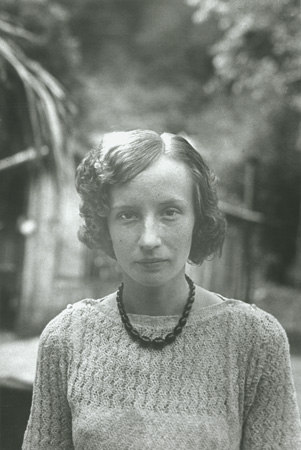
Tatiana Proskouriakoff (1909-1985) took a different route to color. She was one of the great archaeologists of the last generation whose work on both the Maya language and the reconstruction of the jade objects, found in the Cenote of Sacrifice, at Chichen Itza, are considered by many to be two of the outstanding accomplishments of modern Maya archaeology.
Tatiana Proskouriakoff at Piedras Negras. Image Courtesy of the University of Pennsylvania Museum.
Initially educated as an architect, she later went on to work for Linton Satterthwaite and for the University of Pennsylvania Museum at the Maya site of Piedras Negras in 1936–37. Her greatest intellectual contribution however, was a major breakthrough in the decipherment of Maya hieroglyphic writing. Utilizing the new linguistic ideas of Yuri Knorozov, she discovered that the writing on monumental stela, found throughout the Maya world, were in fact historical in nature, recording the birth, accession, and death dates for Maya rulers. Analyzing the pattern of dates and hieroglyphs, she was able to demonstrate a sequence of seven rulers who ruled over a span of two hundred years.
Starting in 1958 until her death, she was a curator at the Peabody Museum at Harvard and worked on the reconstruction of Maya jades dredged up from the watery depths of the Cenote. The Cenote contained jade, wooden objects, bones, tools, jewelry, gold, and textiles and represents one of the most important Maya archaeological sites in the Yucatan of Mexico.
The jades found in the Cenote were recovered by the archaeologist Edward H. Thomas between 1910 and 1917 and for the most part were highly fragmentary and had to be reconstructed. Their fragmentary nature come about from the thermal shock experienced by most of them as they had been heated on the coals of an incense burner before being cast into the sacred waters of the Cenote.
Jade was traded widely in Mesoamerica and was one of the most important stones to the ancient Maya. The trade routes upon which it moved are still not well understood nor are the beginnings of its use and carving. The jades studied by Proskouriakoff come from across the Maya world as the Cenote at Chichen Itza was a popular pilgrimage site that contained many styles, colors and forms of this important mineral.
Classic Period Jade Plague from the Jay I. Kislak Collection. Geography and Map Division, Library of Congress.
Proskouriakoff presented the fruits of her almost 20 years of research on the jades found by Thompson, along with her reconstructions, in a now seminal book entitled, Jades from the Cenote of Sacrifice, Chichen Itza, Yucatan, published by the Peabody Museum for Archaeology and Ethnography, in 1974.
Page from Jades from the Cenote of Sacrifice showing Prouskouriakoff's reconstructions of fragmentary jades as gray areas. Kislak Collection, Geography and Map Division, Library of Congress.
Page from Jades from the Cenote of Sacrifice showing Prouskouriakoff’s reconstructions of fragmentary jades as gray areas. Kislak Collection, Geography and Map Division, Library of Congress.
Although the hundreds of reproductions in Proskouriakoff’s  book give one a good sense of the form of the object, an important missing element is color. Jade is found in a wide variety of colors from almost white, through the various familiar shades of green, all the way to purple and nearly black, depending on the kind of trace elements in contains.
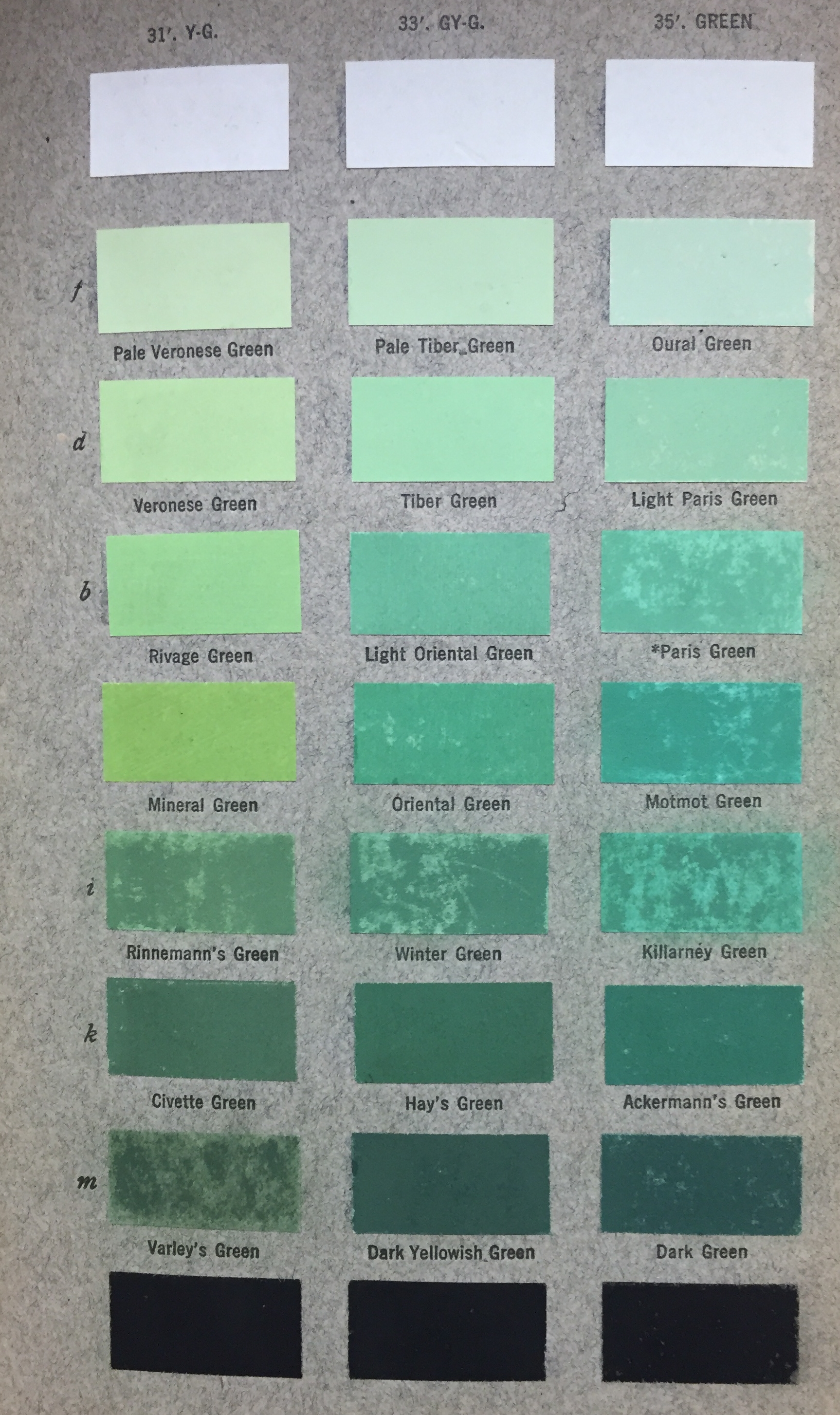
Even though book was printed in black and white, Proskouriakoff does record the color of the jades by referencing a color standard developed to describe birds in the field by Robert Ridgway, the curator of birds at the Smithsonian Institution (when it was called the United States National Museum), in 1912. The book, which is now quite rare, contains color samples of some 1115 individual named colors that Ridgway says are, “made from the finest pigments available.” Ridgway’s book is a marvel of color and presentation with both white and black standards on every page. The book itself was incredibly difficult to produce and was finally published only after the “most perplexing and discouraging problems in chemistry,” were solved.
One of the many green color plates from Ridgway's book used by Tatiana Proskouriakoff to describe the color of the jades from the Cenote of Sacrifice. Collections of the Library of Congress.
One of the many green color plates from Ridgway’s book used by Tatiana Proskouriakoff to describe the color of the jades from the Cenote of Sacrifice. Collections of the Library of Congress.
Many of the colors of the jades that are recorded from the Cenote have names like Hay’s and Rinnemann’s Green as shown in the plate above. In fact, Proskouriakoff develops a typology of jades, categorizing 15 classes based purely on appearance with no reference to mineralogical type.  She tries as best a she can to describe what the jade looks like in language,  breaking her classes into more detailed subclasses, for example writes of her Class 2 jades:
Class 2
Jades of vivid, concentrated green. No grain is visible in the green, which tends to diffuse as it merges with colorless matter. Several distinct varieties may be distinguished.
Class 2a. Probably the finest of jades, a brilliant Killarney or Hay’s Green, subtranslucent, with only occasional colorless patches and black blotches or veins that may be due to burning.
[…]
This was a truly original way to express the color dimension and allowed those who could not come to see the originals to at least gain some sense of the wide range of colors represented by the jades in the Cenote of Sacrifice. In this work Proskouriakoff had hoped to advance some of the research that had been accomplished by Foshag, and also by A.V. Kidder, by looking at the possible locations of various jades styles, performing what today we might call a spatial network analysis. She recognized the problem with trying to understand the provenance of much of the jade that had been discovered at the Cenote, explaining that,
[…] the Sacrificial Cenote collection offers us few new data on the uses of jade, since no assemblages have been found. The amount of material, however, permits some observations on the association of distinct jade varieties with certain styles and techniques of carving. Both Foshag and Kidder note that in Guatemala the quality of jades tends to differ in different regions. At Kaminaljuyu, Foshag distinguished seven varieties of jade, four of which were jadeities, and the others, diopside jade, albitic jade, and chloromelinaite. He observed that these jades fall into a much more uniform and distinct classes than do the jades from Nebaj, and he was unable to incorporate the latter into his system.
 If, as Obrist’s tells us, curation is mostly imagination and creativity, then Tatiana Proskouriakoff’s color scheme was truly imaginative, referencing color through names and samples that could be seen, and, although they could not capture the  infinite variability of perception, were certainly an interesting example and practical solution to at least one curatorial problem….. 
Color has always been a difficult concept, and as expressed in the quote that opened this post, it can only be experienced and not really described in language[1]. As Stephen Houston writes,
[…] the act of seeing far outstrips the ability of language to name color. An infinity of perceptions has no possible match in a finite set of labels, no matter how inventive or poetically conceived those labels might be.  


[1] Readers interested in the concepts and theories surrounding color in Mesoamerica should read, Veiled Brightness: A History of Ancient Maya Color, by Stephen Houston and Claudia Brittenham, published by the University of Texas Press (2009). The book presents a history of the many theories of color, along with a concise survey Maya color terms, as well as technical information relating to specific pigments, dyes and paints used in the Classic period. Joseh Albers’ book, The Interaction of Color, is also recommended in that it provides an artists notes and optical exercises showing how colors interact with each other and produce particular effects. This title has been recently republished by Yale University Press. For those interested in color names and their cultural stability and variability in Mesoamerica see, Robert E. MacLaury’s Color and Cognition in Mesoamerica: Constructing Catagories and Vantages from 1996, which details fieldwork in collecting color names and meanings from more than 100 indigenous languages. For more on the significance of color in archaeological research see A. Jones and G. MacGregor’s edited collection, Colouring the Past: the significance of colour in archaeological research, from 2002. 

Wednesday, May 09, 2018

Disappearing Acts:
the Life and Death of a Great Alpine Glacier

Using Nineteenth Century Sources to Study the melting of the Glacier Blanc

.....

..... field geographers can speak with authority about the clarifying effects on the mind of direct physical danger in the real world and there exists a terrible antagonism between field geographers and armchair academics. Not only do those in their armchairs think and write junk, obfuscation, obscurantism, and endlessly convoluted self-referral to their literature in windowless libraries, they do not care about the human condition.”

--William Bunge,
Geography is a Field Subject
Area, 1983

This paper is a shorter version of talk given in 2010 and that will be published later this year.
See the session Measuring Environmental Impact at the Institute of Historical Research, University of London School for Advanced Studies, and my paper Disappearing Worlds.

The Glacier Blanc is the largest glacier in the Southern Alps. From the Dome des Ecrins it reaches a height of 4014 meters down to its snout at 2315 meters, the glacier covers an area of 5.34  square km, extends 5.9 km in length and has a mean slope of approximately 30%.  Measurements have been carried out on the Glacier Blanc since the late nineteenth century with the first real quantitative study in 1887.
Glacier Blanc from the Dome de Neige des Ecrins (click on image to enlarge)

Click on Images to Enlarge
Several important studies have summarized the historical variation of the glacier's mass balance, length and thickness. (see Thibert, E., J. Faure and C. Vincent. 2005. "Bilans de masse du Glacier Blanc entre 1952, 1981 et 2002 obtenus par mode`les nume´riques de terrain". Houille Blanche 2, 72–78.)

Approaching the Glacier Blanc from the Village of Alfoid  (click on image to enlarge)

The approach to the Refuge des Ecrins (click on image to enlarge)
In the center section the main stream the Glacier Blanc is about 800 to 1000 metres wide. The greatest depth of ice occurs near the Refuge des Écrins where it is up to 250 metres deep; some 30 metres less than it was in 1985. My visit  to the glacier this summer showed that the glacier had shrunk back significantly from its previous position leaving only exposed rock near the lower Refuge du Glacier Blanc.

The map below, last updated in in 1991, shows the position of the glacier relative to the refuge, and portrays the snout many tens of meters further down the valley than its present location. The glacier flows at a speed of around 40 meters per year in its central section (in the mid-1980s it moved at 50 m/yr) and at about 30 metres per year near its snout. Its reaction time, i.e. the time that elapses before the foot of the glacier advances or retreats due to major changes in conditions in the accumulation zone, is about 6 years. So the melting we are seeing now is a window into the recent past. 


Map of the area around the Glacier Blanc showing the Refuges Ecrins, Blanc, and Cezanne along with the Glacier Blanc's smaller and rock covered partner, the Glacier Noir  (click on map to enlarge)
Glacier Blanc in the Summer of 2012 (click on image to enlarge)

Schematic of the Structure of the Glacier Blanc (click on image to enlarge)
As with almost all alpine glaciers, the foot of the Glacier Blanc has retreated significantly, as should be evident from the graph of its length below. In earlier times, most recently in 1866, it formed a single glacial system with its southern neighbour, the moraine-covered Glacier Noir, whose streams joined one another above the Pré de Madame Carle. The Glacier Noir is much different in morphology than the Glacier Blanc and is covered with rockfall and boulders from its lateral moraines.
Glacier Noir  (click on image to enlarge)
During the Small Ice Age the combined ice system reached its maximum extent in 1815 and ended roughly at the height of the Cezanne Hut (1,874 m), near the village of Alfoid. Today looking at the Refuge de Cezanne and the Pre Madame Carle it is difficult to believe that the two glaciers ever extended that far down the valley.


Map of Historic Extent of the Noir and Blanc

Refuge de Cezanne near the historic confluence of the Glaciers Blanc and Noir (click on image to enlarge)
There are many sources for glacial heating and the thermodynamics of glaciers is quite complex requiring the solution of several different complex differential equations.

For more of the solutions to theses equations and modeiling of glacier energy balances see the notes Thermodynamics of Glaciers from the McCarthy Summer School at the University of Alaska. Characterizing the heat sources is further complicated by the difficulties in making field measurements for some areas on mountain glaciers that have complex or irregular geometries.


As of 2010 the tongue of the Glacier Blanc lies at a height of about 2,400 m. In the 20th century it is estimated that it retreated by about 1 km, accompanied by a reduction in area of some 2 km². Between 1989 and 1999 alone the glacier lost about 210 metres; it retreated a further 300 metres in the years to 2006. The ice thickness in the centre reduced during the period from 1981 to 2002 by 13.5 metres, an estimated loss in volume of 70 million m³ of ice.


Seracs on the Glacier Blanc in 2012  (click on image to enlarge)
Crucial to the survival of a glacier is its mass balance, the difference between accumulation and ablation (melting and sublimation). Climate change may cause variations in both temperature and snowfall, causing changes in mass balance. Changes in mass balance control a glacier's long term behavior and is the most sensitive climate indicator on a glacier.From 1980-2008 the mean cumulative mass loss of glaciers reporting mass balance to the World Glacier Monitoring Service is -12 m. This includes 19 consecutive years of negative mass balances.

A glacier with a sustained negative balance is out of equilibrium and will retreat, while one with a sustained positive balance is out of equilibrium and will advance. Glacier retreat results in the loss of the low elevation region of the glacier. Since higher elevations are cooler than lower ones, the disappearance of the lowest portion of the glacier reduces overall ablation, thereby increasing mass balance and potentially reestablishing equilibrium. However, if the mass balance of a significant portion of the accumulation zone of the glacier is negative, it is in disequilibrium with the local climate. Such a glacier will melt away with a continuation of this local climate.The key symptom of a glacier in disequilibrium is thinning along the entire length of the glacier.bare, melting and has thinned.

In the case of positive mass balance, the glacier will continue to advance expanding its low elevation area, resulting in more melting. If this still does not create an equilibrium balance the glacier will continue to advance. If a glacier is near a large body of water, especially an ocean, the glacier may advance until iceberg calving losses bring about equilibrium.
Melt Zone outlet in the summer 2012  (click on image to enlarge)
For the first time since 2001 the mass balance of the Glacier Blanc became positive. It has gained 21 cm (water equivalent) over the last few years. However the snout remains very thin and is vulnerable to another hot summer, such as the kind we are experiencing here in the northeastern United States this year.

The last few year’s positive figures have not really effected the glaciers disappearance, as the snout of the glacier is still retreating. 

For more on the Glacier Blanc see glaciologist Mauri Pelto's excellent analysis on his website From a Glacier's Perspective,

Author taking a rest at the Refuge du Glacier Blanc  (click on image to enlarge)
Many historical sources that could help us in our efforts to understand the melting of the great Alpine Glaciers remain locked up in small and obscure local journals and travelers accounts. Many of these where published in the things like the annual of the Alpine Club of France, or in traveler's account like James Forbes' Journals of Excursions in the High Alps of the Dauphine. Forbes, pictured below, was one of the first scientist/explorers of the Alps to understand the principles of glacier mechanics and it is through his Travels through the Alps of Savoy that we can get a sense of how difficult to do glacier science was in the mid-nineteenth century.


There are many more obscure sources however like the measurements of Prince Roland Bonaparte who cataloged the sizes of many of the glaciers of the Dauphine in the 1880s and 90s.


Bonaparte took many photographs (click on images to enlarge) of his Alpine travels and a comparison of the landscape that he encountered with what is currently ice covered is quite shocking. One of Bonaparte's publications, Le glacier de l'Aletsch focuses on his journey across the glacier in 1888-89.


The Aletsch Glacier or Great Aletsch Glacier is the largest glacier in the Alps. It has a length of about 23 km (14 mi) and covers more than 120 square kilometres (46 sq mi) in the eastern Bernese Alps in the Swiss canton of Valais. The Aletsch Glacier is composed by three smaller glaciers converging at Concordia, where its thickness is estimated to be near 1 km. It then continues towards the Rhone valley before giving birth to the Massa River.

The Aletsch, because of its size is one of fastest shrinking glaciers in the alpine chain as it apparent from the three images below taken in 1979, 1991 and 2002. (click on images to enlarge)


The Aletsch Glacier has been studied for almost 200 years. This data has been compiled by the Swiss Glacier monitoring network and is shown graphically below.


The entire area around the glacier has been declared a UNESCO world heritage site. The United States Geological Survey has begun a Repeated Photographs Study that seeks to show in dramatic form the extent of glacial melting using historic photos. For example in Glacier National Park they have looked closely at the Grinnell Glacier from various vantage points.


Most alpine glaciers are in trouble and some have become dangerous as their melting has caused the formation of large glacial lakes in places where few had been before. About a decade ago a second lake appeared in front of the Arsine glacier just across the Barre des Ecrins from the Glacier Blanc. I visited this series of glaciers several year ago just after the snow melt, crossing the large moraines that are left behind from its larger bygone days.

The author approaching the calving front of the Arsine Glacier (click on image to enlarge)


Arsine Glacier as mapped in 1979 and in 2008 (click on images to enlarge) Note the creation of a second lake due to the melting glacier


To give the viewer an idea of the scale of these glaciers, note the author in the center of the photograph

Glacial melting not only affects the activities of climbers and geographers but also the daily lives of those who live in villages near mountain environments and those make their livings from them. One of the best recent studies glacial melting from this perspective can be found in the book In the Shadow of Melting Glaciers: Climate Change and Andean Society by Mark Carey. Carey's book has been the subject of much discussion and was the subject of an H-Environment Round table Review in 2011.


For more on the melting of glaciers worldwide and their mapping go to the resources available at Glacier Works and at the Extreme Ice Survey .


For more on glaciology and the effect of climate change on glaciers see:

H. Holzhauser, "Glacier Fluctuations in the western Swiss and French Alps in the 16th Century," Climate Change 43 (1999) : 223-37.

H. Holzhauser, "Glacier and glacial-lake variations in west-central Europe over the last 3500 years," The Holocene 15 (2005): 791-803.

Roger Hooke, Principles of Glacier Mechanics (Prentice Hall, 1998)

A. Nesje and S.O. Dahl, Glaciers and Environmental Change (London: Arnold, 2000)

Ben Orlove, Ellen Wiegandt and Brian Luckmann, Darkening Peaks: Glacier Retreat, Science and Society, (University of California Press, 2008)

W.S.B. Patterson, The Physics of Glaciers (Butterworth-Heinemann, 2001)

Daniel Steiner, "Two Alpine Glaciers over the Past Two Centuries: a scientific view based on pictorial sources," in Darkening Peaks (2008): 83-99

Wednesday, May 03, 2017

Looking for Chomsky in Paris:
Early Morning Reflections on Mesoamerican Linguistics and the Preservation of Indigenous Manuscripts

Time and money are spent in collecting the remains in wood and stone, in pottery and in tissue and bone, in laboriously collating isolated words, and in measuring ancient constructions…But closer to the very self, to thought and being, are the connected expressions of men in their own tongues.                                                                       --D. Brinton (1883)
There is in reality never a permanent, stable equilibrium in any language. We thus pose the principle of the incessant transformation of languages as absolute. The case of an idiom which finds itself in a state of rest and equilibrium cannot be found.
--F. Saussure 


Paris may seem like an unlikely place to find yourself pondering the origins, diversity, and collecting of ancient Mesoamerican languages, but the sun, the quiet and the caffeine of the cafes appear to have, at least in me, a profound focusing effect on the mind. Perhaps this is why generations of Paris intellectuals have done their best writing in places like Le Select, La Rostand and the Café Flore.

I have seemingly, if not done some of my best writing, then certainly have accomplished some of my best reading and thinking while staring out into the streets from a small table accompanied by copious amount of coffee. It is in places like this, whether in Paris or in all night dinners in New York City, where I have absorbed some of the great classics in linguistics and the philosophy of language. The works of Ludwig Wittgenstein, Fritz Staal’s essays on the ancient Sanskrit grammarians, Ferdinand de Saussure's Cours de Linguistique Générale from 1916 (the 100th anniversary conference was happening during my visit), Gottlieb Frege’s articles


 on sense and reference, Saul Kripke's amazing Naming and Necessity, and most importantly, Aspects of a Theory of Syntax and Syntactic Structures, by Noam Chomsky, have been read slowly over the years with a small notebook close at hand.

Author Imaging the Codex Xolotl in the Bibliothèque nationale de France, June 2016
As a linguist and curator more mathematically inclined than language proficient, these works fired my imagination and made me think of language in more analytical ways. I was amazed to find linguists like Staal arguing that ancient grammarians, trying to find a systematic grammar for Sanskrit, had applied a kind of recursion theory to language and hypothesized a generative system for grammar of the kind that would not be postulated again until Chomsky’s work in the 1950’s[1]. The earliest methods of generative construction proposed by these grammarians, especially Pāṇini, who lived in the fourth century BCE, allowed for the development of discrete, potentially infinite language systems. The formal basis for Panini's methods involved the use of what today would be called “auxiliary" markers, first utilized by the logician Emil Post for the description of computer languages[2].

It was Chomsky however, especially his early writings on the formal and computational structure of grammar, such as, “Three Models for the Description of Language” (1956), “On certain formal properties of grammars” (1959) and “The algebraic theory of context free languages” (1963), that spurred my imagination. I can remember clearly the days when I first read Syntactic Structures, many years ago, while soaking up the sun in the Luxembourg Gardens. I saw in this short, yet dense work, for the first time, a profound computational basis for the analysis of grammars that could be applied across time, space, and in spite the performative, external differences found in individual languages.

Authors Old Notes on Chomsky's Lectures, Language and Mind, delivered at University of California, Berkeley in 1967

In Syntactic Structures Chomsky clearly outlines the idea that a grammar is a set of rules, or algorithms, whose goal is two-fold. First, these rules can be used to generate the sentences of the associated languages and only those sentences, and second they can be employed as a kind of decision procedure to classify and determine whether a given sentence is an element of a particular language or not.

While this may seem somewhat obvious, it is not easy to find simple grammars that span and generate an entire language, especially ancient languages which have been subject to change over the millennium and whose spoken and documentary evidence is quite limited and perhaps even tainted by the passing of time. In most cases we are in this position with many New World languages, including those of Mesoamerica, whose cultures languages have seen a great deal of change over the last 500 years, and whose first grammars and lexicons were written down by non-native Spanish clerics after the conquest[3].

For Chomsky there are three possible forms of grammar of increasing complexity: Finite-state, Phase structure and Transformational.  The first of these grammars, the finite-state form is capable, just like real languages, of generating an infinite number of sentences from a finite number of primitive elements. These elements can be morphemes, phonemes or words. Morphemes are the smallest grammatically functioning elements of a language, for example ‘girl’ and ‘s’ in ‘girls’. In Chomsky’s terms these kinds of languages form what is known as a “finite-state Markov processes.” I would later come to specialize in the mathematics of these processes whose complexity is nearly infinite.

One can think of this type of grammar as a kind of machine. Chomsky notes that “this conception of grammar is an extremely powerful and general one,” and that “In producing a sentence, the speaker begins in some initial state, produces the first word of the sentence, thereby switching into the second state which limits the choice of the second word…[4]”. This continues with each new state the speaker passes through having different limits and restrictions imposed on the choice of the next word by the grammar.

There are no spoken human languages that can be completely modeled using finite-state grammars and hence higher levels of formal complexity must be added. Phase Structure grammars are far more complex, and they can generate sentences that cannot be given by finite-state machines.  In one sense you can think of finite state machines as generating the infinite component of language and phase structure grammars as generating the complexity and variability.

Although it took me sometime to understand Chomsky’s grammatical hierarchy[5] and his presentation of phase-structure grammars and transformation rules I was drawn deeply to this approach and its possible applicability to real languages[6]

There is another related reason however, besides the contemplation of formal grammars and the minimalist program[7], for a linguist, ethnohistorian or curator interested in Mesoamerican languages to make his or her way to the City of Lights. Housed in that old and storied library on Ave Richelieu is a collection of rare and seldom seen pictorial codices, grammatical manuscripts, vocabularies, orthographic handbooks, and other materials brought together in the 19th century by a small cadre of French manuscript hunters whose interest in the languages of Mexico and Central America bordered on obsessive. 

This small group, composed of eccentrics and travelers like the Abbe Charles Etienne Brasseur de Bourbourg, Leonce Angrand and Joseph Aubin, collected, stole or somehow absconded with some of the most important records relating to the history of ancient Mesoamerican languages to survive from the period of contact  and into the 17th and 18th centuries[8]

Figure 1: Title Page of Bibliothèque nationale de France American Manuscript 63, Arte de la lengua quiche [o] utlatecat with the Ex Libris of Brasseur de Bourbourg. Everything from De Landa’s Relacion, the Popol Vuh and the Madrid Codex passed through his hands.
These collectors were moreover, not merely trophy hunters, but rather expressed through their collecting and in their writings a genuine concern for the preservation of manuscripts and for the ethnohistory and archaeology of the New World. Brasseur de Bourbourg writes in his letter from Guatemala to Rabinal that,

When the current president Rafael Carrera arrived to power his first concern was to recall the clergy, who although their influence was on the decline, were still a reminder of order and civilization.  Their monasteries, libraries and papers were all returned to them—but in what condition!  Most of the works from the libraries were no longer complete and had been eaten by worms.  Sullied manuscripts were falling to pieces covered in a pungent dust.  These are the gains that had been made by knowledge thanks to the revolution and liberalism in Guatemala. […]
 

For three months I was engaged in searching through what remained of these monastic riches. In the library of the University, I found, among the manuscripts of Father Francisco Ximénez a history in Kiché, with an incomplete translation by Ximénez.  I had copied both versions, while also trying to acquire an elementary knowledge of indigenous languages, when His Grace the Archbishop offered me the possibility of administrating the parish of Rabinal...[9]

The grammars and vocabularies that they collected form, in many instances, the basis for study of the historical development of important Central American languages like K’iche, Cakchiquel and Q’eqche. Ephemeral dictionaries, word lists, and grammars, like that of Domingo de Vico (Figure 2), which the anthropologist Robert M. Carmack has called, “the most important source for the study of K’ichean culture,” have only survived because of the activities of these collectors and bibliophiles.

Many of these important linguistic manuscripts have yet to be published and have been little studied in a systematic way. Although some scholars, most notably Munro S. Edmonson, had looked at all of the available major sources, no collation of the contents or of the linguistic variations found with in them has appeared. Edmonson’s now classic, but flawed, Quiche-English Dictionary does give some indication of the main dialectical and regional variations in K’ichee, breaking them up into the Eastern (centered on Rabinal), the Central (centered on Chichicastenango) and the Western (centered on Quezaltenango), but he goes no further. Several authors have called for and suggested that a comprehensive colonial K’ichee dictionary is needed which would preserve the original forms, by transcribing them in the now conventional orthography of the Academia de las Lenguas Mayas de Guatemala, and by noting mistakes of transcription and other possible hints to the manuscripts transmission found in the original (see Frauke Sachse, Documentaion of Colonial K’ichee Dictionaries and Grammars, FAMSI, 2007).

The bibliographic records for the manuscripts found in France, are described for the most part in the Catalogue des Manuscrits Americains de la Bibliotheque Nationale, written and compiled by the longtime curator of manuscripts Henri Omont and published in 1925, but his list gives little indication of the importance of these materials and no systematic details about contents of the originals. Other collections that also house important grammars and vocabularies are those of Leonce Angrand whose archive of notes and letters also survive.

Figure 2: A page from Angrand manuscript 9) in the Bibliothèque nationale de France

For many of these early French collectors and Americanists this was not simply an intellectual exercise performed from some comfortable library or institute in Paris. Most, especially Brasseur de Bourbourg, traveled widely and collected the manuscripts during long and sometimes difficult journeys in Central America. Some of the linguistic work accomplished by these early travelers and collectors is still relevant. Marc Zender, in his often quoted paper One Hundred Years of Nahuatl Decipherment, published in the PARI Journal in the Spring of 2008, writes that,


Aubin's monumental Mémoires sur la peinture didactique et l' écriture figurative des anciens Mexicains, first published in 1849, included lexical identification of over a hundred Nahuatl signs, the recognition of alternating logographic and phonetic spellings of the same names and a detailed study of the glyphic compounds [...] It remains even today a critical reference...

My own journey to these manuscripts starts in Paris years ago but recently, in fact, just a few days I finished looking at some of rarest of these manuscripts and imaging them from the ultraviolet to the infrared for the first time since their discovery more than a century ago. A group of us, led by Jerry Offner from the Houston Museum of Art, and Antonino Cosentino from Cultural Heritage Science Open Source, studied several manuscripts purchased by Joseph Marius Alexis Aubin (another of the great Mesoamerican manuscript hunters) and brought to Paris in the 19th century. For several days we photographed and imaged the very rare and almost never seen Codex Xolotl and Mapa Quinatzin, both written in Nahuatl. 

Fragment of the Codex Xolotl, Bibliothèque nationale de France
The hope is that by using these images we can begin to computationally reconstruct the manuscripts as they were originally made, revealing previously hidden and unread sections that might be of interest to scholars studying the history of the Valley of Mexico in the 15th century.

Antonino Cosentino from Cultural Heritage Science Open Source looking at section of the
Codex Xolotl (BnF, Paris)in Ultra Violet light


[1] For more on this see Fritz Staal, Universals, Studies in Indian Logic and Linguistics  (Chicago: University of Chicago Press, 1988); R. Briggs, “Knowledge Representation in Sanskrit and Artificial Intelligence,” AI Magazine 6(1985) 22-38 and especially Saroja Bhate and Subhash Kak, “Panini’s Grammar and Computer Science,” Annals of the Bhandarkar Oriental Research Institute 72 (1993) 79-94.
[2] Kadvany, John (2007). "Positional Value and Linguistic Recursion". Journal of Indian Philosophy 35: 487–520.
[3] For an important case study on these lexicons and the difficulties in using this important source of linguistic information see Frauke Sachse, “Reconstructing the Anonymous Franciscan K’ichee Dictionary,” Mexicon 31 (2009) 10-18.
[4] Noam Chomsky, Syntactic Structures (New York: Mouton de Gruyter, 1957) 20
[5] The Chomsky hierarchy is sometimes referred to as the Chomsky-Schutzenberger Hierarchy. See Noam Chomsky and Marcel P. Schutzenberger, “The algebraic theory of context free languages,” in Computer Programming and Formal Languages, edited by P. Braffort (Amsterdam: North-Holland Publishing, 1963) 118-161.
[6] For more on the theoretical grammars outlined by Chomsky see Howard Lasnik, Syntactic Structures Revisited: Contemporary Lectures on Classic Transformational Grammar (Cambridge: MIT Press, 2000) and Geoffrey Poole, Syntactic Theory (New York: Palgrave Macmillan, 2002).
[7] Minimalism is name of the current form of the generative enterprise and the Principles and Parameters approach. For more see Noam Chomsky, The Minimalist Program (Cambridge: MIT Press, 1995).
[8] A good and up-to-date description of these collectors, which is also sympathetic to the ethical boundaries of the 19th century, can be found in Wendy Kramer and George Lovell’s paper “Pillage in the Archives: The Whereabouts of Guatemalan Documentary Treasures,” Latin American Research Review 48 (2013) 153-167
[9]  Translation of Brasseur de Bourbourg’s letters provided by Katia Sainson from her forthcoming collection of Brasseur’s travel writings. (University of Oklahoma Press, Fall 2017)